Vampire Tour New Orleans French Quarter: Ghosts, Voodoo, Anne Rice and the Real Legends
Booking a vampire tour New Orleans French Quarter regulars actually rate means answering three questions at once. Which walk covers the documented history, which one covers Anne Rice's real addresses, and which one passes the streets people recognise from the screen. The Original French Quarter Night Walk answers all three on a single two-hour route, and it carries 4.5 stars from 3,015 verified reviews. This page covers what the walk actually stops at, the Anne Rice geography behind it, what Interview with the Vampire and The Originals genuinely filmed in the city, and how the walk sits against the other night tours in our New Orleans vampire tour comparison.
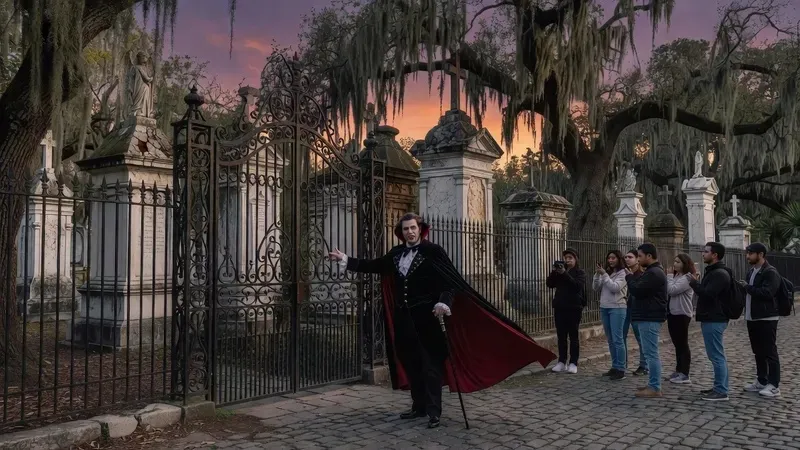
Tour at a Glance
Which French Quarter Night Walk to Pick
Three night walks cover this ground, and they are not interchangeable. The honest version, tour by tour:
The Original French Quarter Night Walk, $33
This is the walk this page is about, and it is the one to take if the history is the point. Two hours, roughly one mile, licensed local guide, and the longest stop list of the three: LaLaurie Mansion, Jacques St. Germain's former house, the New Orleans Pharmacy Museum and Jackson Square. It is also the only one of the three that reliably works in the Anne Rice material and the screen locations rather than treating them as an afterthought.
Its 4.5 rating is the lowest of the three, and that is worth knowing rather than hiding: across 3,015 reviews the recurring complaint is that group sizes swell on Friday and Saturday nights in October, when everyone in the city wants the same 8 pm slot. Book a weeknight and that complaint mostly disappears. See dates and prices.
The #1 Haunted Tour with Hurricane cocktail, $22
The cheapest of the three and the highest rated at 4.8 from 1,247 reviews, running 1 hour 45 minutes over under a mile. It leans on LaLaurie Mansion and Lafitte's Blacksmith Shop and includes a two-for-one Hurricane voucher, which is a real saving in a city where a Hurricane runs about $14. What it does not do is go deep on the Rice material or the Jacques St. Germain case.
If your budget is the deciding factor, or you are walking with someone whose stamina is limited, take the $22 walk and read the literary background here instead.
The HELLVISION™ true crime experience, $37
Adults only, 4.7 from 166 reviews, two hours, with handheld projectors that throw recreated historical scenes onto the buildings as the guide talks. It passes Marie Laveau's house and Lafitte's Blacksmith Shop. The review count is small compared with the other two, so treat the rating as promising rather than settled.
Take the projector tour if the visual staging appeals and nobody in your group is under 18. Our breakdown of which walks suit which ages has the full age policy for all three.
The Three French Quarter Vampire Walks
Featured walks leave the Quarter after dark and carry free cancellation up to 24 hours before departure.
from $33
Ghosts, Voodoo & Vampires: The Original French Quarter Night Walk
Walk the French Quarter with a licensed guide through sites tied to real vampire legend — LaLaurie Mansion, the New Orleans Pharmacy Museum, Jackson Square, and the house…
- LaLaurie Mansion & Jacques St. Germain's house
- New Orleans Pharmacy Museum stop
- Jackson Square at night
- Licensed local guide
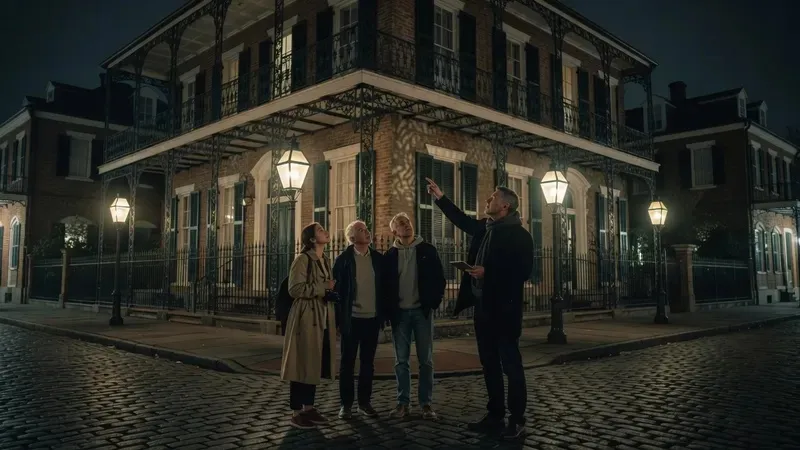 from $37
True Crime, Voodoo & Vampires: The HELLVISION™ Night Experience
A French Quarter walking tour with optional HELLVISION™ handheld projectors that recreate frightening historical scenes as your guide narrates. The route passes Marie Laveau's house and Lafitte's Blacksmith…
- HELLVISION™ visual projection technology
- Marie Laveau's house
- Lafitte's Blacksmith Shop
- True crime & vampire history
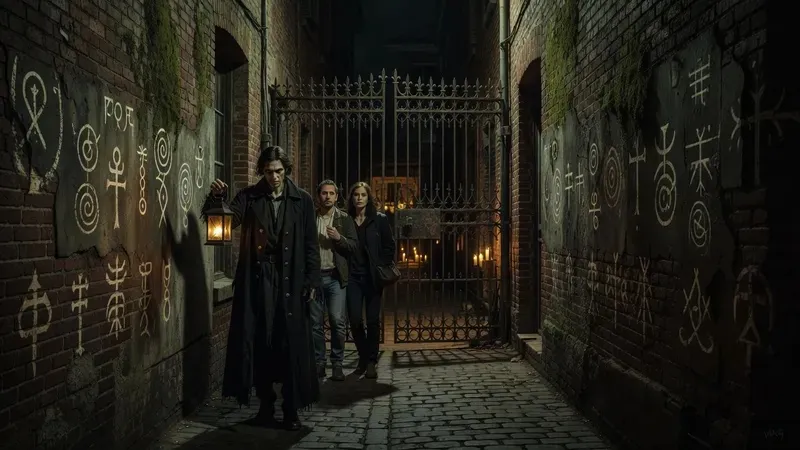 from $22
The #1 Haunted Tour: French Quarter Ghosts & Vampires + Hurricane Cocktail
Voted New Orleans' #1 Haunted Tour eight years running by TripAdvisor, this French Quarter walk hits LaLaurie Mansion, Lafitte's Blacksmith Shop, and the city's darkest alleys — and…
- Voted #1 Haunted Tour 8 years running
- Two-for-one Hurricane cocktail voucher included
- LaLaurie Mansion & Lafitte's Blacksmith Shop
- Under 1 mile — easy walking
Which Walk Covers Which Ground
The literary and screen material is the part most comparison tables leave out, so here it is directly.
| Walk | Duration | Price | Book | Literary and screen ground covered | Rating |
|---|---|---|---|---|---|
| Original night walk | 2 hours | $33 | Check Availability | Anne Rice addresses, Interview with the Vampire streets, LaLaurie as seen on screen | 4.5 ★ |
| HELLVISION™ true crime | 2 hours | $37 | Check Availability | Marie Laveau and true crime, projected scene recreations, little literary content | 4.7 ★ |
| #1 Haunted Tour | 1h 45m | $22 | Check Availability | LaLaurie Mansion and Lafitte's Blacksmith Shop, light on Rice and St. Germain | 4.8 ★ |
Figures current for Q3 2026. Ratings reflect verified guest scores on the booking platforms.
What the Vampire Tour New Orleans French Quarter Covers
LaLaurie Mansion, 1140 Royal Street
The walk passes 1140 Royal Street early. The LaLaurie Mansion is not folklore. Delphine LaLaurie tortured enslaved people in the attic of this house in the 1830s, and when a fire broke out on 10 April 1834 the people who forced their way in found victims chained in conditions that made the New Orleans press report on a slaveholder's household at a time when it almost never did.
LaLaurie fled to France and was never prosecuted. The house has been a private residence, a girls' school and an apartment building since, and Nicolas Cage owned it briefly before financial trouble forced the sale. It is privately owned today, a grey creole townhouse behind cast-iron balconies, and nobody goes inside.
You stand on the pavement and look up at it, which is the correct way to encounter it.
Jacques St. Germain's house
The most genuinely unsettling stop on the route is the Royal Street residence connected to Jacques St. Germain, a Frenchman who arrived in the city around 1902 claiming descent from the Count of St. Germain, a historical figure already rumoured in Europe to be deathless. He entertained constantly and was never seen to eat, only to drink wine. In 1903 a woman jumped from an upstairs window and told police he had bitten her neck.
Officers searching the house reported no food in it and bottles of wine mixed with what they described as blood. St. Germain had gone by the time they returned. Our guides present this as a legend with a paper trail rather than as a proven case, and the difference matters.
The records behind it are laid out story by story in our account of the city's vampire legends.
New Orleans Pharmacy Museum, 514 Chartres Street
The Pharmacy Museum occupies the shop of Louis Dufilho Jr., who in 1816 became the first licensed pharmacist in the United States. The daytime museum tells that story. The night walk adds what sat on the same shelves: laudanum, arsenic cosmetics sold to women who wanted the pallor of the consumptive, gris-gris ingredients, and the experimental compounds of a century when the line between a chemist and an occultist was thinner than either would admit.
This stop is on the Original Night Walk route and not on the other two, and it is one of the clearest reasons to pay the extra $11 over the cheapest walk.
The Ursuline Convent and Jackson Square
The route takes in the Old Ursuline Convent on Chartres Street, the oldest surviving building in the Mississippi Valley, completed in 1753, and closes at Jackson Square. The square empties out after 9 pm. The tarot readers and buskers who work it by day are gone, the St. Louis Cathedral facade is lit from below, and the guide uses that setting to make the closing argument: that New Orleans built its supernatural reputation out of genuinely layered material, French and Spanish colonial law, Haitian arrivals after 1791, a large free Creole population, Catholic ritual and West African practice sitting side by side, and cemeteries where the dead are stored above ground because the water table leaves no choice.
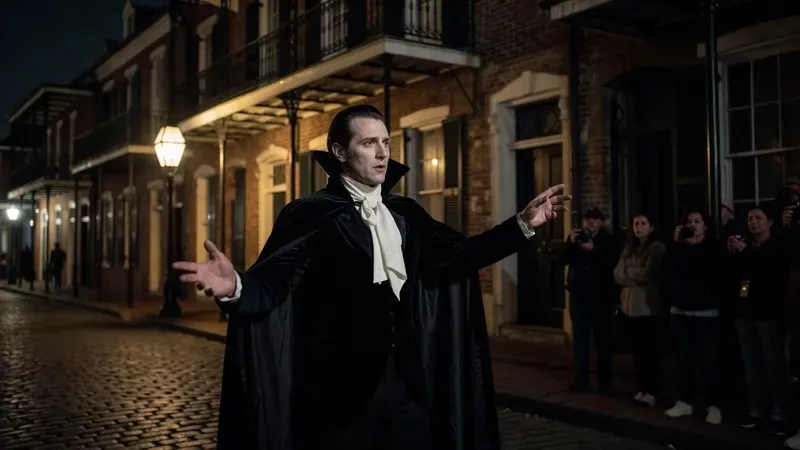
Anne Rice's French Quarter: The Real Addresses
From the Irish Channel to the Vampire Chronicles
Anne Rice was born Howard Allen Frances O'Brien in New Orleans in 1941 and grew up in the Irish Channel, a short streetcar ride from the Quarter. She left for Texas and then California, and wrote Interview with the Vampire in 1976 while grieving the death of her daughter Michele from leukaemia. The novel's preoccupation with watching everyone you love die while you continue came from that.
The geography came from memory. She reconstructed a city she was not living in, which is why the descriptions read as inventory rather than atmosphere.
Gallier House, 1132 Royal Street
This is the address Rice readers most often want and most often miss. Rice said she used Gallier House at 1132 Royal Street as the model for the Rue Royale townhouse where Louis, Lestat and Claudia live. It is the 1857 home the architect James Gallier Jr. built for his own family, and unlike almost every other building on this list it is open to the public as a house museum during the day, with the interior arrangement Rice was working from.
The night walk passes it on Royal Street. If you care about the novel, go inside during daylight hours before you take the walk, then see the same facade after dark. It is eight blocks from Jackson Square.
1239 First Street, and why it is not on this route
Rice came back to New Orleans in 1988 and bought the Brevard-Rice House at 1239 First Street in the Garden District, where she wrote much of the later Vampire Chronicles and the Mayfair Witches books, and where she threw the Halloween parties that became city events. It is a private residence today and you can only look at it from the pavement. It is about two miles from the Quarter, which is why no French Quarter walking tour reaches it.
The St. Charles streetcar gets you within a few blocks in around 25 minutes from Canal Street. Treat it as a separate afternoon rather than something a night walk can deliver.
Lafayette Cemetery No. 1 and Metairie Cemetery
Lafayette Cemetery No. 1 on Washington Avenue, opposite Commander's Palace in the Garden District, is the cemetery most tied to Rice. It stands in for the Mayfair family ground in her fiction, and in 1995 she staged a jazz-funeral procession into it to launch Memnoch the Devil, arriving in a coffin. It has been closed to general visitors for structural restoration for several years now, so check its current status before crossing town for it.
Rice died in December 2021 and is interred in the family tomb at Metairie Cemetery, further out and reachable by car or rideshare. Neither cemetery is on any French Quarter route.
Interview with the Vampire: Novel, 1994 Film, AMC Series
What the novel put on the map
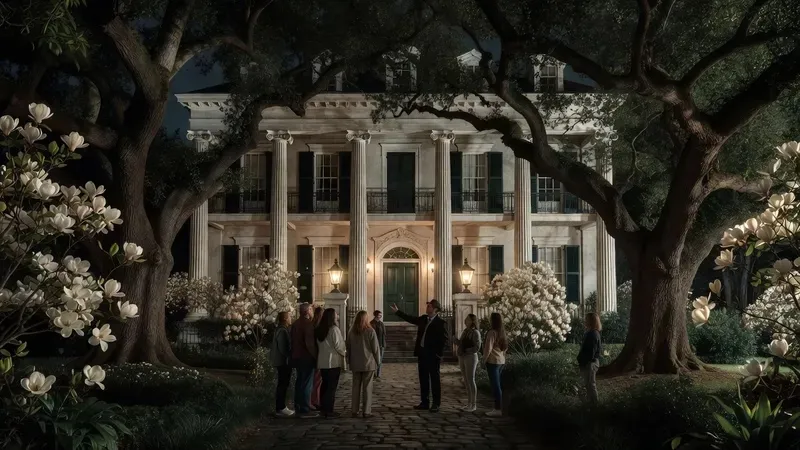
The 1976 novel is set in late 18th and early 19th century New Orleans and it does not invent streets. The creole townhouse Rice describes, three storeys, iron-lace balcony, a courtyard behind, commercial space at ground level, is a real building type that still lines Royal and Chartres. The Quarter you walk tonight was largely rebuilt after the fires of 1788 and 1794, so what survives is Spanish colonial and American antebellum construction, exactly the period the novel inhabits.
The Theatre of the Vampires, worth saying plainly, is in Paris in the book and not in Louisiana.
What the 1994 film actually shot here
Neil Jordan's adaptation with Tom Cruise, Brad Pitt and Kirsten Dunst did film in Louisiana, and the French Quarter street work is genuine, shot at night with the modern fittings dressed out. Oak Alley Plantation at Vacherie, about an hour upriver from the city, supplied the plantation exteriors. Much of the rest was not here: the Paris sequences were shot in Paris, and a large share of the interiors were built at Pinewood Studios in England.
So the honest position is that the film used the real Quarter for exteriors and built the rest. A guide who tells you a given doorway is the doorway from the film is usually guessing.
The AMC series and 1910s Creole New Orleans
The AMC series that began in October 2022 moves Louis from a 1790s plantation owner to a Creole man of colour running businesses in the Storyville-era Quarter, which lets it deal with the racial architecture of the real city far more directly than the novel did. Its first season shot extensively on location in and around New Orleans, and it shows in the light and the humidity. Production for the later Paris storyline moved substantially to Prague, so not everything on screen after season one is Louisiana.
The series also draws on the Casket Girls material, which is local folklore that predates Rice by two and a half centuries rather than anything she invented.
Walking it without a script
None of the three walks is a screen-location tour and none claims to be. What the Original Night Walk gives a reader or a viewer is the real material underneath: the house where the documented atrocity happened, the address behind the St. Germain story, the convent behind the Casket Girls, and the square that every establishing shot of this city uses. Guides on the new orleans vampire tours we compare are licensed by the city, which means they sat an examination on local history, and the good ones will tell you which parts of the evening are record, which are newspaper, and which are oral tradition.
The Vampire Diaries, The Originals and What Was Really Filmed Here
This is where visitor expectations and the facts part company most often, so it is worth being blunt about it.
The Vampire Diaries is not a New Orleans show. It is set in the fictional town of Mystic Falls, Virginia, and it was filmed in Georgia, principally in and around Covington outside Atlanta. Fans do make the trip to Covington to see the town square from the series. There is nothing in the French Quarter to see from it, and any tour selling itself as a Vampire Diaries tour of New Orleans is selling you the spinoff under the parent show's name.
The spinoff is The Originals, which ran from 2013 to 2018 and is set in New Orleans. Its production was based in Georgia like its parent show, with the Mikaelson compound and most interiors built and shot there, and it used New Orleans for location and second-unit work: French Quarter street footage, the St. Louis Cathedral and Jackson Square in establishing shots, above-ground cemetery scenes, and Royal Street exteriors in the stretch that includes the LaLaurie house. So the streets are real and the compound is not.
What that means practically: the Original French Quarter Night Walk passes the real locations the establishing shots used, and the guide will point out where the camera stood if you ask. It is a history walk that happens to cross the show's ground, not a fan tour with a shooting script. Anyone expecting props, costumes or scene-by-scene recreations should book something else, or take the projector walk, which at least stages its recreations deliberately.
The Vampire Legends Behind the Route
The Casket Girls
New Orleans vampire lore predates Anne Rice by 250 years. In the 1720s the French colonial administration shipped young women to Louisiana as prospective wives for settlers, and they arrived carrying cassettes, chest-shaped cases for their belongings, which local memory turned into caskets. They were housed at the Ursuline Convent.
The legend holds that some of the passengers were not women, and that the third-floor shutters were later nailed shut to contain what came off the ships. The convent's third-floor shutters are, in practice, almost always closed. The convent as it stands was completed in 1753, which is a problem for a legend dated to the 1720s, and our guides say so.
The Carter brothers
The story told on most walks is that in the 1930s two brothers, John and Wayne Carter, kept victims bound in a Chartres Street room and drank their blood, and were executed for it. It is a genuinely frightening piece of oral tradition and it belongs on a night walk. What it does not have is a paper trail: no execution records and no contemporary newspaper coverage matching the account have surfaced.
Take it as the folklore it is.
Why the city grew this material
None of it is accidental. New Orleans spent its formative century under French and then Spanish law rather than English common law, absorbed a large Haitian population after the revolution of 1791, sustained a free Creole population with no equivalent elsewhere in the American South, and practised a Catholicism that lived alongside West African religion instead of prosecuting it. Add cemeteries where the dead are stacked above ground in whitewashed vaults because the water table forbids anything else, and a vampire story stops feeling imported.
We take the whole catalogue apart, legend by legend, with the verdict on each, in our account of what the records actually show.
How the Night Walk Feels
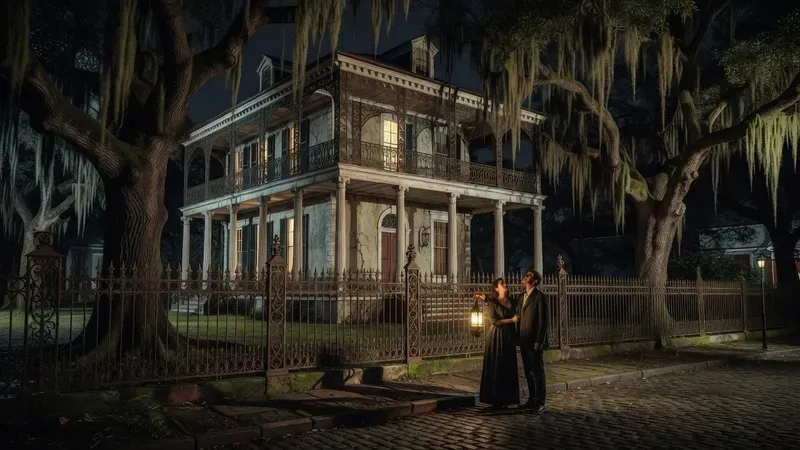
The Quarter genuinely changes after dark. Foot traffic thins out past 9 pm away from Bourbon Street, the lanterns on Royal and Chartres put amber pools on the flagstones, and the residential blocks go quiet enough that a guide can talk without raising their voice.
Group size is the variable that decides whether the evening works. This walk is normally kept small enough that you can ask a question and get an answer, but the 8 pm departures on October weekends are the exception, and that is exactly when most visitors book. A 6 pm departure or any weeknight is a materially different experience for the same $33.
The pace is unhurried. Two hours covers about a mile with real stops, not a march past addresses. There are no stairs and no climbing on the route, but the surfaces are uneven brick and flagstone that has been there a long time, and there is no indoor portion at all. The walk runs in light rain.
Where the Route Runs
The walk stays inside the French Quarter, between Jackson Square and the residential blocks of Royal and Chartres. Every address it passes is plotted stop by stop in our French Quarter route guide.
- Jackson Square Where the walk closes, under the St. Louis Cathedral facade
- 1140 Royal Street LaLaurie Mansion, viewed from the pavement only
- 1132 Royal Street Gallier House, Anne Rice's model for the Rue Royale townhouse
- 514 Chartres Street New Orleans Pharmacy Museum, on this route only
- 1100 Chartres Street Old Ursuline Convent, the Casket Girls building
Important Things to Know
What to bring
- Closed-toe walking shoes with grip: the brick and flagstone is uneven and unlit in places
- Insect repellent from March through November, when the Quarter's evening mosquitoes are constant
- Water: Louisiana humidity does not drop much after sunset
- A phone or camera: the gaslit blocks photograph well, and there is no photography restriction on the route
- A packable rain layer, because the walk goes ahead in light rain
Not allowed
- Open drinks: the group moves constantly and the operator asks you not to carry them
- Pets: narrow pavements and a moving group make it unsafe
- Large backpacks or wheeled luggage: the route runs single file in places
- Children under 13 on this walk, which the operator enforces for the historical content
Timing and booking
- Departures run nightly; the 6 pm slot is quieter than 8 pm year round
- October and the weeks around Mardi Gras sell out days ahead, especially Friday and Saturday
- Free cancellation applies up to 24 hours before departure
- Confirm your exact meeting pin from the booking email; it is a street corner, not an office
Who This Walk Is For
A good fit if
- You want the documented history rather than staged scares, with the guide flagging what is record and what is legend
- You read Anne Rice and want the real Royal Street addresses behind the Vampire Chronicles
- You came to the city because of Interview with the Vampire in any of its versions and want the material underneath it
- You are a first-time visitor and want one evening that explains why this city produced all of it
- You are travelling solo or as a couple and want a licensed guide for a night walk through the Quarter
- True crime interests you as much as folklore, since the route carries both
Not suitable for
- Anyone wanting an official Anne Rice estate, AMC or CW experience, because no such tour exists here
- Children under 13, given the antebellum torture and criminal history the route covers
- Guests with limited mobility: two hours on uneven historic paving with no indoor break
- Anyone hoping to reach the Garden District, Lafayette Cemetery or Metairie Cemetery, which no French Quarter walk covers
- Visitors who want jump scares and actors rather than history
Frequently Asked Questions
Where does the vampire tour in the New Orleans French Quarter meet?
The meeting point is a street corner inside the Quarter, usually near Jackson Square or a designated Royal Street address, and the exact pin comes through in your booking confirmation email. There is no ticket office to collect from. Arrive ten minutes early, because guides leave on time with a full group.
Which Anne Rice locations does the walk actually pass?
Gallier House at 1132 Royal Street, the model for the Rue Royale townhouse in Interview with the Vampire, is on the route, as are the Royal and Chartres blocks she described and the Old Ursuline Convent. Her own home at 1239 First Street is in the Garden District, roughly two miles away, and no French Quarter walk reaches it. Compare what each of the three night walks covers before you book.
Will the walk visit filming locations from Interview with the Vampire?
It passes real French Quarter streets that the 1994 film and the AMC series both used for exteriors and establishing shots, and a guide will point out where cameras stood if you ask. It is not sold as a screen-location tour. The 1994 film built many of its interiors at Pinewood Studios in England and shot its plantation scenes at Oak Alley in Vacherie, an hour upriver, so a large part of what you remember from it was never filmed in the Quarter at all.
Is this an official Anne Rice, AMC or Vampire Diaries tour?
No. All three walks are independent licensed history tours with no affiliation to Anne Rice's estate, AMC, or The CW. The Vampire Diaries was set in Virginia and filmed in Georgia, so nothing in New Orleans relates to it; The Originals is the New Orleans-set spinoff, and the streets it used for exteriors are the ones the original night walk covers.
How far do you walk on the vampire tour?
About one mile over two hours, entirely on surface streets with no stairs. The pace is slow because the stops are long. The difficulty is the uneven brick and flagstone paving rather than the distance. Every address on the route is mapped in our stop-by-stop French Quarter route guide.
What happens if it rains?
The walk goes ahead in light rain and the guide continues unless there is a severe weather warning, so bring a packable layer rather than assuming a cancellation. If the operator does cancel for weather you receive a full refund, and free cancellation for any other reason applies up to 24 hours before departure.
Can I visit Anne Rice's grave while I am in the city?
Yes, but not on this walk. Rice is interred in the family tomb at Metairie Cemetery, well outside the Quarter and reachable by car or rideshare in about 15 minutes. It is open during daylight hours and it is a remarkable Victorian garden cemetery in its own right, worth the trip whatever your interest in the novels.
Do I need to book in advance or can I just show up?
Book ahead. Friday and Saturday evening departures sell out regularly, and from October through Mardi Gras they go days in advance. Free cancellation up to 24 hours before means locking in a date early costs you nothing. Compare dates and prices across every New Orleans vampire tour before you choose.