The Real Vampire Stories Behind New Orleans' Tours
The real New Orleans vampire stories told on the city's tours are built on five recurring legends, and only one of them holds up as documented history. Guides tell the Casket Girls, Jacques St. Germain, the Carter Brothers, Anne Rice's fiction and the Creole lougawou every night in the French Quarter, and each one earns its place for a different reason: a genuine historical event stretched past what the record supports, a newspaper story nobody can fully confirm, an outright invention, or fiction that reshaped how the whole city gets talked about. We walk these streets for a living, so below is the honest version of each story, told the way guides tell it and then checked against what actually survives in the archives. None of this is meant to spoil the telling. It is meant to help you enjoy it with open eyes, and to know which stops belong to the ghost and vampire walk lineup when you are ready to book one.
Quick answer
The strongest of the real New Orleans vampire stories is Jacques St. Germain's 1903 window incident, which has a newspaper record even though it can't be fully verified. The Casket Girls and the Carter Brothers are pure folklore attached to real history, and Anne Rice's fiction is the reason the whole city reads as vampire country today. Every story below is framed as the legend it is, with the historical record set alongside it.
Key takeaways
- Jacques St. Germain's 1903 blood incident has a documented newspaper trail, though the arrest itself was never confirmed
- The Casket Girls arrived as real 1728 brides, not vampires, and the convent building tied to their legend was not even built until 1751
- The Carter Brothers story has no execution records anywhere in Louisiana, despite being told as fact on some walks
- Anne Rice's Vampire Chronicles, not any historical case, are why New Orleans is considered vampire country
- See the exact route and stops these legends are told at, address by address
- Hear the Casket Girls and St. Germain stories told in full on the most-reviewed night walk
The Legends at a Glance
Five stories account for nearly everything a guide tells you about vampires in New Orleans. Some are historical events wearing a supernatural costume, one is closer to true crime reporting than folklore, and one is admittedly fiction that happened to reshape how an entire city is understood. The table below sorts them by what actually survives in the record, not by how good the story sounds at midnight.
| Legend | The story | What the records say | Verdict |
|---|---|---|---|
| The Casket Girls | French brides arrived in 1728 carrying cassettes rumored to hold something undead | The convent tied to the legend wasn't completed until 1751, and the cassettes were too small for a body | Pure folklore |
| Jacques St. Germain | A woman leapt from his window in 1903 claiming he drank her blood | A newspaper account exists; no confirmed arrest record survives, and he vanished before questioning | Legend with a paper trail |
| The Carter Brothers | Two dockworkers allegedly drained victims in the 1930s and were executed for it | No execution, court, or newspaper record for either brother has ever surfaced | Pure folklore |
| Anne Rice's New Orleans | Her Vampire Chronicles turned the city's real houses and cemeteries into vampire landmarks | The houses are real and the connection is documented, but the vampires are admitted fiction | Literary, not legend |
| The Lougawou | A shape-shifting, blood-drinking figure from Louisiana Creole and Haitian tradition | A genuine, separately documented folk tradition predating the European vampire craze here | Pure folklore |
The Casket Girls
The story, told on the tour: in 1728, a shipment of young Frenchwomen arrived in New Orleans to become brides for the colony's men, nicknamed filles à la cassette for the small wooden trunks, or cassettes, that carried their belongings. They stepped off the ship pale from months at sea, and rumor followed them: something in those trunks wasn't clothing. The version guides tell outside the Old Ursuline Convent on Chartres Street is specific.
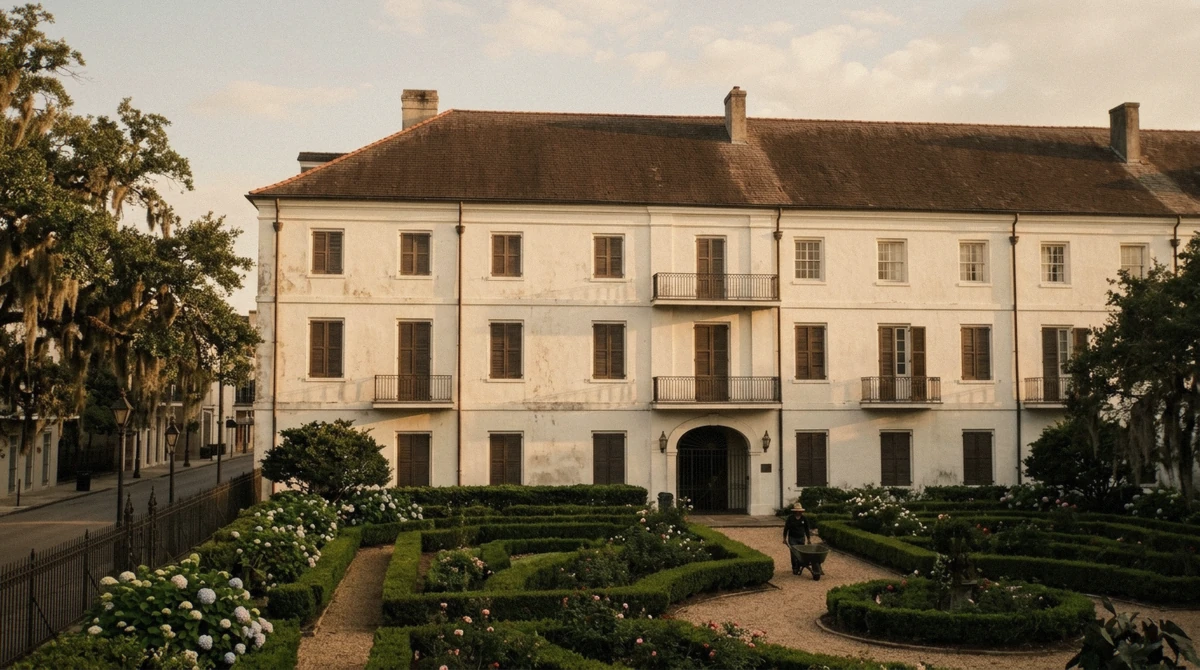
The third-floor shutters, they say, have stayed nailed shut ever since, sealed with nails blessed by the Pope himself to keep whatever the girls carried from getting out.
- Records list ordinary cassette contents: petticoats, headdresses, sewing supplies
- The girls were real; the French crown really did send brides to the colony
- The vampire reading is a modern addition, not an 18th-century belief
What the records say: the surviving Ursuline Convent building, the one guides point to, was not completed until 1751, roughly twenty-three years after the Casket Girls arrived. Whatever happened to that first generation of brides, it did not happen in the building the tour stops at. The cassettes themselves were small enough to carry aboard a ship and hold folded clothing, nothing more. And the vampire framing has a traceable birthday: it only attached itself to the Casket Girls after Anne Rice's novels made New Orleans synonymous with vampires in the 1970s and 1980s. Before that, they were simply a footnote in colonial immigration history.
Verdict: pure folklore, layered onto a real historical migration that had nothing supernatural about it. The convent, the girls, and the year 1728 are all genuine. The sealed shutters and the blessed nails are the storytelling that grew up around them generations later.
Jacques St. Germain
The story, told on the tour: in 1902, a wealthy Frenchman named Jacques St. Germain arrived in New Orleans claiming descent from the real 18th-century Comte de Saint-Germain, a European court figure who claimed to be centuries old and was famous for never eating at his own dinner parties. St. Germain kept the same habit here. Guides pause outside his former house at 1039 Royal Street to tell what happened one December night in 1903: a woman jumped from the second-story window, telling police on the street that he had bitten her.
Officers who searched the house reportedly found bloodstains and wine bottles mixed with blood. By the time anyone came to question him, St. Germain was gone, and no one ever saw him in the city again.
- The house at 1039 Royal Street, at the corner of Ursulines Avenue, still stands
- A woman's fall and her accusation are part of the newspaper-era retelling
- St. Germain's disappearance is the detail that keeps the story alive
What the records say: this is the closest thing to a documented incident in the whole lineup. A period account of the window fall and the accusation exists in the retellings that have circulated since, but no verified arrest record, court filing, or contemporary police report has survived to confirm the details the way a modern true-crime case would be confirmed. That gap is exactly what keeps the story in the tour rotation rather than the history books: there is enough of a paper trail to make it feel real, and not quite enough to prove it.
Verdict: legend with a paper trail. Something happened at that address in 1903 involving an accusation dramatic enough to survive more than a century of retelling. Whether it happened the way the story is told today is impossible to confirm one way or the other, and any tour that tells it as settled fact is filling in a gap the record leaves open.
The Carter Brothers
The story, told on the tour: John and Wayne Carter, dockworkers in the French Quarter during the 1930s, kept victims tied up in an apartment and drained their blood over a period of months. The version usually ends with a girl escaping and running for the police, and with both brothers standing trial and being executed for the murders. It is the most graphic of the five legends, and on some walks it is the one told closest to the LaLaurie Mansion stop, where the true-crime framing of the night already has the crowd primed for it.
- No first names beyond "John" and "Wayne" appear consistently across retellings
- The apartment is never tied to a specific surviving address
- The story is told as settled fact on some routes, with no caveat
What the records say: researchers who have gone looking for John or Wayne Carter have found nothing. There is no execution record for either name in Louisiana, no trial transcript, no court filing, and critically, no newspaper coverage of what would have been one of the most sensational crimes in the city's history if it happened as told. A case involving multiple victims, a dramatic escape, and a double execution would have made front pages for weeks. It made none.
Verdict: pure folklore, with no supporting record of any kind. Of the five legends here, this is the one told most often as unqualified fact and supported least by anything that survives. We tell it as a story, because it is a genuinely effective one on a dark street, not because there is a case file behind it.
Anne Rice's New Orleans
Anne Rice lived much of her life in New Orleans, and more than any single legend, her fiction is the reason the city reads as vampire territory today. Gallier House at 1132 Royal Street, an 1857 townhouse designed by architect James Gallier Jr., is the building Rice herself said matched what she had imagined for Louis and Lestat's Rue Royale home, and it appears again in the first season of the 2022 television adaptation. Her own former home, a Greek Revival mansion at 1239 First Street in the Garden District, became the model for the Mayfair house in The Witching Hour.
Lafayette Cemetery No. 1, at 1400 Washington Avenue, holds the cast-iron Karstendiek family tomb that fans nickname Lestat's tomb, and St. Elizabeth's Orphanage at 1314 Napoleon Avenue was a real building Rice owned and restored.
| Location | Address | Connection |
|---|---|---|
| Gallier House | 1132 Royal Street | Rice's model for Louis and Lestat's Rue Royale townhouse; a museum today |
| Anne Rice's former home | 1239 First Street | Garden District mansion, model for the Mayfair house in The Witching Hour |
| Lafayette Cemetery No. 1 | 1400 Washington Avenue | Cast-iron Karstendiek tomb fans nickname "Lestat's tomb" |
| St. Elizabeth's Orphanage | 1314 Napoleon Avenue | Owned and restored by Rice; appears in her work |
Interview with the Vampire filmed in the city both for the 1994 film and again for the 2022 television series, and The Originals used the French Quarter as its setting for five seasons. None of it is claimed as history, and none of it needs to be. Rice's fiction did something the older legends never managed: it gave New Orleans a permanent, specific identity as vampire country, and every other legend on this page gets read through that lens now, whether it predates her novels or not.
Verdict: literary, not legend, and arguably the most influential of the five stories precisely because it never pretended to be true. If you want the addresses laid out for a dedicated walk, our guide to the Anne Rice and screen locations on the night walk covers the full list and breaks down what was really filmed where.
The Lougawou
Not every blood-drinking figure in Louisiana folklore came from a European vampire novel or a French Quarter newspaper story. Louisiana Creole folklore, carried down from French and Haitian tradition, has its own shape-shifting, blood-drinking figure called the lougawou, a name derived from the French loup-garou. Told in Creole communities across the region for generations, the lougawou long predates the vampire craze that Anne Rice's novels later brought to the city, and it belongs to a genuinely separate storytelling tradition rather than a New Orleans invention.
- The lougawou shifts shape rather than simply drinking blood in human form
- The tradition is Creole and Haitian in origin, distinct from European vampire lore
- It has been told in these communities for generations, independent of the tourist legends
Verdict: pure folklore, but of a different kind than the debunked hoaxes above. The Casket Girls and the Carter Brothers are stories that got stretched past what the record supports. The lougawou was never presented as documented history in the first place; it is a living oral tradition, carried and retold on its own terms long before anyone in New Orleans had heard of Jacques St. Germain.
History or Invention: How We Sort Them
The four verdicts above aren't arbitrary. Each one reflects a different relationship between a story and the paper trail behind it, and knowing the difference is the whole point of telling these stories honestly rather than as flat fact.
- Documented incident, disputed reading: a real, dated event survives in the record, but how it should be interpreted is genuinely open
- Legend with a paper trail: contemporary accounts exist, but key details, like an arrest record, were never confirmed and can't be checked today
- Pure folklore: no supporting record exists at all, even when the story is told as settled fact on some tours
- Literary, not legend: openly acknowledged fiction, notable because of how much it shaped the city's identity anyway
We think the honest version is the better one to hear on a dark street, not the flattened one. A story that survives contact with the archive, like Jacques St. Germain's, earns its chills honestly. A story that doesn't, like the Carter Brothers, is still worth telling, but worth telling as the folklore it is.
Guides who blur that line aren't lying so much as skipping a step, and we'd rather you know which step got skipped.
Where the Tours Tell These Stories
Every legend above gets told at a specific address, not in the abstract, which is part of why the tours work. The original ghosts, voodoo and vampires walk covers the Casket Girls at the Ursuline Convent and Jacques St. Germain's house on the same route, alongside the New Orleans Pharmacy Museum. The true crime and voodoo experience leans harder into the Carter Brothers framing and the darker end of the storytelling. The award-winning $22 walk keeps the pace brisk and closes at Lafitte's Blacksmith Shop, where the Anne Rice connection and the evening's Hurricane cocktail voucher both come into play.
- Casket Girls and St. Germain: told together on the route that includes the Ursuline Convent
- Carter Brothers: told with the true-crime framing on the darkest of the walks
- Anne Rice locations: referenced on the route, with the full address list on the dedicated guide
- Lougawou: mentioned as context for the city's wider voodoo and folklore traditions
Frequently Asked Questions
What are the real vampire stories behind New Orleans' tours?
Five legends make up nearly the whole tour circuit: the Casket Girls, Jacques St. Germain, the Carter Brothers, Anne Rice's fiction, and the Creole lougawou. Only St. Germain's 1903 case has any surviving newspaper trail; the rest range from pure folklore to admitted fiction.
Were the Casket Girls actually vampires?
No. They were real Frenchwomen who arrived around 1728 as brides for the colony. The vampire reading is a modern addition that only attached itself to the story after Anne Rice's novels, and the convent building tied to the legend wasn't even completed until 1751.
Was Jacques St. Germain a real person?
A man by that name did live at 1039 Royal Street and claimed descent from the historical Comte de Saint-Germain. The 1903 window incident has a newspaper-era account behind it, but no confirmed arrest record survives, which is why we call it a legend with a paper trail rather than settled history.
Did the Carter Brothers actually exist?
No verified evidence of them does. No execution, court, or newspaper record for either brother has ever surfaced in Louisiana, despite the story sometimes being told on tours as unqualified fact.
Which Anne Rice locations do the tours pass?
Gallier House at 1132 Royal Street, her former home at 1239 First Street in the Garden District, Lafayette Cemetery No. 1, and St. Elizabeth's Orphanage all connect to her work. Not every route stops at every address; the original night walk guide lays out which ones it passes.
What is the lougawou?
A shape-shifting, blood-drinking figure from Louisiana Creole and Haitian folk tradition, distinct from the European vampire myth and told in Creole communities for generations, well before the city's tourist-era vampire legends took shape.